






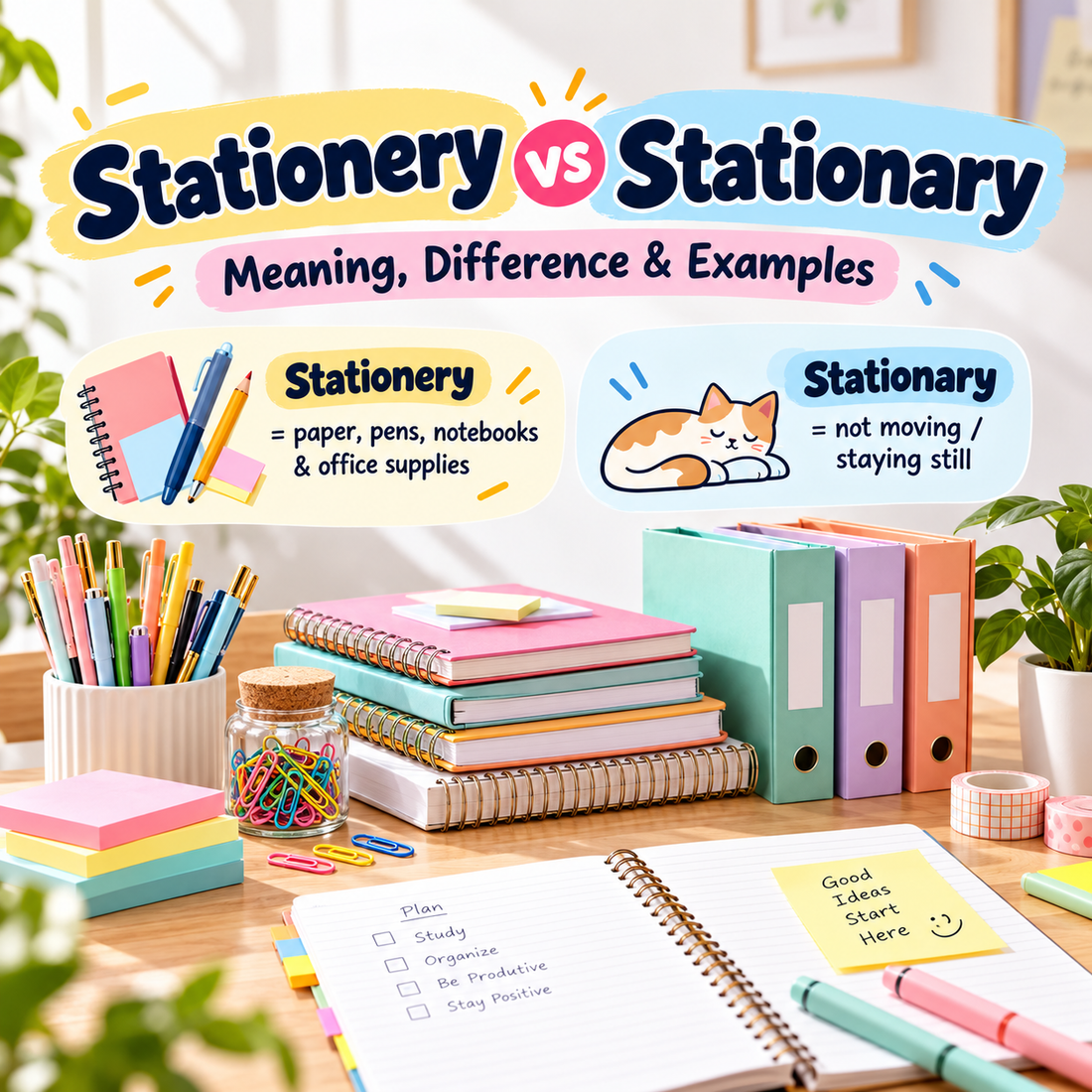
Have you ever stopped while writing an email or completing an assignment because you were unsure whether to write stationery or stationary? Don't worry. You are not alone. These two words sound exactly the same, and their spellings differ by just one letter. However, their meanings are completely different.
Understanding stationery vs stationary becomes much easier once you know what each word describes. One is related to everyday writing supplies, such as pens, notebooks, paper, and files. The other describes something that is not moving.
For example, when you buy a new notebook for school, you are buying stationery. When your bicycle is parked outside and is not moving, it is stationary.
Although the difference seems small, using the wrong word can change the meaning of your sentence. The good news is that you can remember the correct spelling with a simple trick.
Let's understand the meaning of both words, explore their differences, and look at practical examples that will help you use them correctly.
What Is the Difference Between Stationery and Stationary?
The main difference between stationery and stationary is their meaning and usage.
Stationery is a noun that refers to writing materials and office supplies, including notebooks, pens, pencils, envelopes, paper, and files.
Stationary is an adjective that describes something that is not moving or is remaining in one position.
Here is a quick comparison to make the difference clear.
| Feature | Stationery | Stationary |
|---|---|---|
| Meaning | Writing materials and office supplies | Not moving or staying in one position |
| Part of speech | Noun | Adjective |
| Common usage | School, office, writing, and art supplies | Vehicles, objects, machines, and people |
| Example | I bought stationery for my new school year. | The car remained stationary at the traffic light. |
| Memory trick | Stationery has an 'e' for envelopes. | Stationary has an 'a' for at rest. |
Remember this simple distinction: if you are talking about pens, notebooks, paper, or other writing supplies, use stationery. If you are describing something that is not moving, use stationary.
What Does Stationery Mean?
Stationery refers to the materials people use for writing, drawing, printing, studying, and completing office work.
Think about the items you carry in your school bag or keep on your office desk. Your notebooks, pens, pencils, sticky notes, folders, and writing paper are all examples of stationery.
Stationery is commonly used by students, teachers, office employees, artists, businesses, and anyone who works with written documents.
Common Examples of Stationery Items
Some everyday stationery items include:
-
Notebooks and registers
-
Pens, pencils, and erasers
-
A4 sheets and printing paper
-
Files, folders, and document holders
-
Sticky notes and paper clips
-
Markers, highlighters, and correction tapes
-
Envelopes and letter-writing paper
-
Art paper and drawing supplies
These products may look simple, but they play an important role in everyday activities. Students use them to complete assignments, teachers use them to prepare lessons, and professionals rely on them to organize documents and manage office work.
How to Use Stationery in a Sentence
Here are a few examples that show how to use the word stationery correctly.
-
I need to buy new stationery before school reopens.
-
Our office ordered stationery for the entire team.
-
She keeps all her stationery neatly arranged in a drawer.
-
The teacher asked students to bring their own stationery for the examination.
-
We visited a stationery shop to purchase notebooks and coloured markers.
In each sentence, stationery refers to writing materials or related supplies.
What Is a Stationery Shop?
A stationery shop is a store that sells writing materials, school supplies, office products, and other paper-based items.
You can usually find notebooks, pens, pencils, files, envelopes, art supplies, and printing paper in a stationery shop. Some stores also offer printing, photocopying, binding, and other document-related services.
Students often visit stationery shops before a new academic year, while businesses purchase stationery to keep their offices organized.
If you are looking for supplies for school, college, or everyday office work, a stationery shop is the right place to start.
What Does Stationary Mean?
The word stationary describes a person, object, or vehicle that is not moving. It can also describe something that remains in the same position or does not change during a particular period.
Unlike stationery, stationary is not the name of a product or a collection of writing materials. It is an adjective used to describe a condition or state.
For example, imagine waiting at a traffic signal. Your car is not moving while you wait for the light to turn green. During that time, your car is stationary.
How to Use Stationary in a Sentence
Let's look at some everyday examples.
-
The bus remained stationary until the traffic cleared.
-
Please keep the camera stationary while taking the photograph.
-
The cyclist kept his bicycle stationary near the entrance.
-
The machine must remain stationary during the inspection.
-
The athlete stood stationary at the starting line.
Notice that stationary describes the position or condition of something in these examples.
Where Is the Word Stationary Commonly Used?
You may encounter stationary in several situations.
Transportation: A parked car, a stopped train, or a vehicle waiting at a traffic signal can be described as stationary.
Photography and filming: A stationary camera remains in one position rather than moving around.
Sports and exercise: A person may remain stationary while performing a particular exercise or waiting for instructions.
Machinery: Certain machines or components must remain stationary during maintenance, inspection, or operation.
Science: The word can describe an object that remains at rest relative to a specified reference point.
Understanding these examples makes it easier to recognize when stationary is the correct word.
Stationery vs Stationary: Examples in Everyday English
Sometimes, the easiest way to understand two similar words is to see them used in realistic situations.
Consider the following sentences.
Example 1: Shopping for School Supplies
Correct: I went to the market to buy stationery for my exams.
Incorrect: I went to the market to buy stationary for my exams.
Why? The sentence refers to school supplies, so stationery is the correct choice.
Example 2: Waiting at a Traffic Signal
Correct: The car remained stationary at the red light.
Incorrect: The car remained stationery at the red light.
Why? The sentence describes a car that is not moving. Therefore, stationary is the correct word.
Example 3: Organizing an Office
Correct: The company purchased stationery for its employees.
Incorrect: The company purchased stationary for its employees.
Why? The company is purchasing office supplies, not describing something that is at rest.
Example 4: Taking a Photograph
Correct: Keep the camera stationary to capture a clear image.
Incorrect: Keep the camera stationery to capture a clear image.
Why? The camera needs to remain in one position, so stationary is the appropriate adjective.
These examples show why the difference between stationery and stationary matters. Even though the words sound alike, their meanings determine how they should be used.
How to Remember the Difference Between Stationery and Stationary
If you frequently confuse these words, there is a simple spelling trick that can help.
Remember: E for Envelopes, A for At Rest
Stationery = E for Envelopes
The word stationery contains the letter 'e'. Think of envelopes, which are common stationery items.
Whenever you think about pens, paper, notebooks, envelopes, or other writing supplies, remember the 'e' in stationery.
Stationary = A for At Rest
The word stationary contains the letter 'a'. Think of the phrase "at rest."
When something is stationary, it is not moving or is remaining in one position.
This memory trick is easy to remember and works well for students, professionals, and anyone learning English.
A Quick Way to Check Yourself
Before using either word, ask yourself one simple question:
Am I talking about writing supplies or something that is not moving?
-
If you mean writing supplies, use stationery.
-
If you mean something that is not moving, use stationary.
For example, if you are writing about buying pens and notebooks, choose stationery. If you are describing a vehicle that has stopped, choose stationary.
With a little practice, choosing the correct word will become much easier.
Common Mistakes People Make With Stationery and Stationary
Because these words have identical pronunciations, it is easy to mix them up while writing. However, a few common mistakes are worth avoiding.
1. Using Stationary When Talking About Office Supplies
Incorrect: We need to order stationary for our office.
Correct: We need to order stationery for our office.
Office supplies are stationery, so the spelling with 'e' is correct.
2. Using Stationery to Describe Something That Is Not Moving
Incorrect: The vehicle remained stationery throughout the inspection.
Correct: The vehicle remained stationary throughout the inspection.
The sentence describes a vehicle that is not moving, making stationary the correct choice.
3. Assuming Both Words Have the Same Meaning
Stationery and stationary are homophones. This means they sound the same but have different meanings and spellings.
Their similar pronunciation does not make them interchangeable. Always consider the context of the sentence before choosing one.
4. Forgetting to Proofread
Even people who know the difference can make spelling mistakes when typing quickly.
If you are writing a school assignment, business email, product description, or website article, take a moment to check which word fits the sentence. A quick proofreading check can prevent an otherwise avoidable error.
Is Stationery a Noun or an Adjective?
Stationery is a noun because it names a category of products: writing materials and office supplies.
For example:
-
I purchased stationery for my new office.
-
The stationery is kept in the cupboard.
In these sentences, stationery refers to supplies or a collection of writing materials.
Is Stationary a Noun or an Adjective?
Stationary is generally used as an adjective because it describes a person or thing that is not moving.
For example:
-
The vehicle is stationary.
-
The camera remained stationary during filming.
In both sentences, stationary describes the condition or position of something.
Understanding the parts of speech can help you choose the correct word when constructing a sentence.
Frequently Asked Questions About Stationery vs Stationary
1. What is the main difference between stationery and stationary?
Stationery refers to writing materials and office supplies, such as notebooks, pens, paper, and files. Stationary describes something that is not moving or remains in one position.
For example, you buy stationery from a shop, while a parked car can be described as stationary.
2. How do you spell stationery correctly?
The correct spelling for writing materials and office supplies is stationery, with an 'e' before the final 'ry'.
A useful way to remember it is to associate the 'e' with envelopes, which are common stationery items.
3. Is it a stationery shop or a stationary shop?
The correct term is stationery shop.
A stationery shop sells products such as pens, notebooks, pencils, files, paper, and other writing supplies. Stationary describes something that is not moving, so it does not fit the intended meaning.
4. What is the meaning of stationary in simple English?
Stationary means not moving or staying in one position.
For example, if a bicycle is parked outside and is not moving, it is stationary.
5. Why are stationery and stationary pronounced the same?
Stationery and stationary are homophones. They have the same pronunciation in standard English but different spellings and meanings.
This is why people often confuse them in writing, even when they understand what they want to say.
6. What is an easy trick to remember stationery vs stationary?
Remember E for Envelopes and A for At Rest.
Stationery contains 'e' and refers to writing supplies, including envelopes. Stationary contains 'a' and describes something that is not moving.
7. Can stationary be used to describe a person?
Yes. Stationary can describe a person who is standing or staying in one position without moving.
For example: "The security guard remained stationary near the entrance."
8. What are some examples of stationery items?
Common stationery items include pens, pencils, notebooks, erasers, markers, paper, envelopes, files, folders, and sticky notes.
These items are commonly used in schools, colleges, offices, and homes.
Conclusion
The difference between stationery and stationary may seem small, but understanding it can make your writing clearer and more accurate.
Remember that stationery refers to writing materials and office supplies, while stationary describes something that is not moving.
Whenever you are unsure which word to use, think of envelopes for stationery and the phrase "at rest" for stationary. This simple trick can help you remember the correct spelling without having to look it up every time.
Whether you are writing a school assignment, preparing an office email, or creating content for your website, using the right word makes your message easier to understand.
Once you understand the difference between these two commonly confused words, you will find it much easier to use them correctly in everyday English.